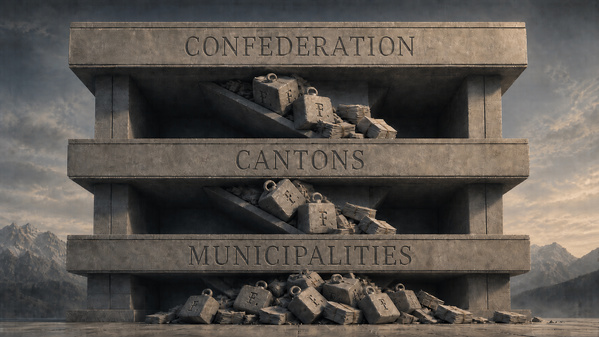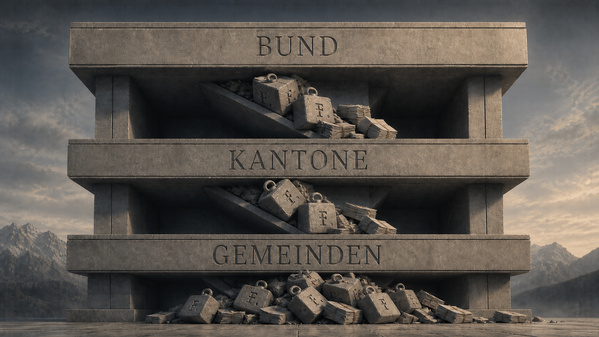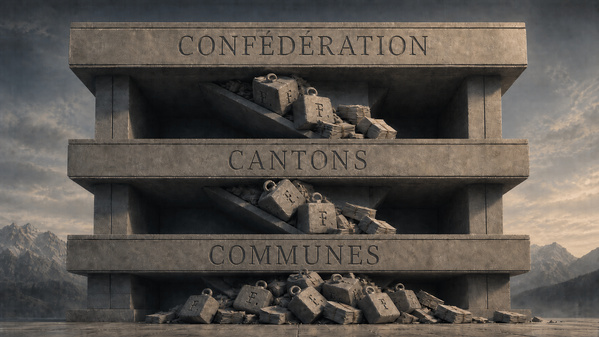
Le 24 avril 2026, la Confédération et les cantons publient le rapport intermédiaire du projet « Désenchevêtrement 27 ». Volume estimé : 4 milliards de francs de tâches à transférer vers la Confédération, 4,8 milliards vers les cantons. Principe affiché : la neutralité budgétaire stricte. Consultation ouverte jusqu'à début juillet, rapport final attendu fin 2027.
Le 26 avril 2026, soit quarante-huit heures plus tard, les Fribourgeois rejettent à 68,57 % la loi sur l'assainissement des finances de l'État (LAFE), qui prévoyait notamment des transferts de charges du canton vers les communes.
Quarante-huit heures. D'un côté, un projet d'envergure nationale qui passe au peigne fin la répartition des tâches entre deux échelons de l'État sur 21 groupes de tâches. De l'autre, un référendum populaire qui sanctionne précisément un déplacement vers le troisième échelon — celui que Désenchevêtrement 27 a soigneusement laissé hors de son périmètre.
Le premier volet de ce diptyque, publié la semaine dernière, défendait une thèse limitée : la Suisse romande et Fribourg gagneraient à se doter d'un frein à l'endettement communal robuste, calibré sur les modèles alémaniques. Diagnostic vrai, mais incomplet. Compléter le frein communal ne suffira pas. Parce que la question qui reste à poser, après la coïncidence des 24 et 26 avril, est plus profonde. Le frein à l'endettement helvétique a-t-il vraiment fonctionné comme une discipline budgétaire ? Ou est-il aussi, en partie, un mécanisme silencieux de tassement des charges en cascade ? Et si oui, comment le réformer sans casser ce qui marche ?
C'est ce que ce second volet propose d'examiner.
Les chiffres du frein fédéral, on les connaît. Dette de la Confédération réduite de 27 milliards entre 2003 et 2019. Taux d'endettement fédéral à 13,5 % du PIB en 2019, 16,1 % fin 2025 même après la pandémie. Selon Avenir Suisse, sans le frein, environ 275 milliards de dette supplémentaires se seraient accumulés depuis 2003. Tout cela est exact.
Mais ces chiffres décrivent un seul étage. Que s'est-il passé pendant ce temps-là aux deux étages du dessous ?
Au niveau cantonal, l'endettement médian est resté stable autour de 15 % du PIB cantonal entre 2010 et 2020. Apparemment rassurant. Mais regardons de plus près les agrégats de charges. À Fribourg, dont le canton est régulièrement classé parmi les meilleurs gestionnaires de Suisse — Avenir Suisse note d'ailleurs en mars 2026 que Fribourg fait partie des quatre seuls cantons (avec Neuchâtel, le Valais et Zoug) à avoir budgétisé un résultat équilibré ou excédentaire pour 2025 — les charges étatiques cantonales ont doublé entre 2003 et 2023, et les charges des communes fribourgeoises ont progressé de 66 % sur la même période. Le canton voisin de Vaud présente le contraste le plus net : sur dix ans, dette cantonale en baisse de 35 %, dette communale en hausse de 27 %.
Ces deux trajectoires ne se compensent pas. Elles s'additionnent. La somme dette cantonale + dette communale dans plusieurs cantons romands a augmenté pendant la période où la dette fédérale baissait. Ce n'est pas un hasard arithmétique. C'est ce qui se passe quand chaque échelon, pris isolément, est tenu à une discipline, mais que personne ne tient les flux entre échelons.
La Conférence des gouvernements cantonaux (CdC) elle-même l'a dit en septembre 2024, par la voix de son président Markus Dieth : « Les transferts de charges directs, qui ne laissent aucune marge de manœuvre aux cantons, ne sont en aucun cas des mesures d'économie et sont fermement rejetés par les gouvernements cantonaux. » Florence Nater, vice-présidente, a renchéri en juin 2025 : « Un assainissement des finances fédérales peut recevoir le soutien des cantons, mais il ne saurait se faire à leur détriment par le biais de transferts unilatéraux de charges. Les contribuables n'y gagneraient rien au change. »
Quand l'organe institutionnel qui représente les 26 gouvernements cantonaux dénonce officiellement et publiquement les transferts de charges comme un faux gain budgétaire, ce n'est plus un soupçon. C'est un constat partagé au plus haut niveau de la hiérarchie institutionnelle suisse. La discipline budgétaire helvétique est un succès au sens où chaque étage, mesuré individuellement, a tenu ses agrégats. Elle est un succès partiel au sens où la somme des disciplines individuelles n'a pas produit une discipline d'ensemble.
C'est ce que j'appelle l'effet d'optique systémique. La dette baisse à l'étage observé, parce qu'une partie des charges glisse à l'étage du dessous. Vue de la Confédération, le frein fédéral est un succès. Vu d'en bas, ce succès s'accompagne d'un déplacement.
Le mécanisme est devenu lisible en juin 2025, quand la CdC a écrit, pour la première fois explicitement, que le programme d'allégement budgétaire 2027 de la Confédération entraînerait « des transferts de charges considérables vers les cantons et les communes ». La cascade complète est désormais nommée par l'institution la plus autorisée à le faire.
Examinons-la concrètement à Fribourg.
Premier transfert : Confédération vers cantons. La Confédération vise 3 milliards d'économies dès 2027 dans son programme d'allégement budgétaire. Une partie significative de ces économies passe par la réduction de transferts vers les cantons dans des domaines à financement conjoint — réduction des primes d'assurance-maladie, prestations complémentaires, formation, transport régional. Les cantons, contractuellement engagés dans ces tâches, encaissent.
Deuxième transfert : canton vers communes. Pour absorber la baisse des transferts fédéraux, les cantons sous contrainte d'équilibre budgétaire (la quasi-totalité d'entre eux, désormais) cherchent eux-mêmes à transférer une part vers les communes. La LAFE fribourgeoise prévoyait précisément, parmi ses 18 mesures, plusieurs adaptations de répartition des charges entre canton et communes. Volume modeste sur le papier — environ 10 millions cumulés sur trois ans selon les chiffres du Conseil d'État. Mais ce volume modeste s'inscrit dans un programme d'assainissement plus large (PAFE) prévoyant 405 millions d'améliorations sur 2026-2028.
Troisième transfert : communes vers contribuables et prestations. Les communes, prises en étau entre des recettes propres rigides (essentiellement l'impôt, plafonné par la concurrence intercommunale et cantonale) et des charges qui montent, n'ont plus que trois leviers : hausser les coefficients fiscaux, réduire les prestations, ou s'endetter davantage. À Ursy, où je siège à l'assemblée communale, le compte 2025 documente la troisième option avec une netteté brutale : taux d'endettement net à 331 %, degré d'autofinancement à 1 %. La marge se rétrécit à vue d'œil.
Le 26 avril, le peuple fribourgeois a stoppé le deuxième transfert. Mais le premier — le programme d'allégement budgétaire 2027 de la Confédération — est, lui, en marche au niveau fédéral. Le canton va devoir l'absorber sans avoir le coussin LAFE. La pression sur les communes ne disparaît pas avec le rejet ; elle se redéploie dans le budget 2026 « bis » que le Conseil d'État doit présenter au Grand Conseil lors de la session de juin, pour entrée en vigueur au 1er juillet.
La cascade ne s'est pas arrêtée le 26 avril. Elle a juste été ralentie d'un cran à un endroit précis. Le diagnostic systémique reste entier.
Pour comprendre pourquoi la cascade existe, il faut revenir à la grande réforme de 2008 : la RPT, Réforme de la péréquation financière et de la répartition des tâches entre la Confédération et les cantons. Acceptée à 64 % en votation populaire en novembre 2004, entrée en vigueur le 1er janvier 2008. Première réorganisation fondamentale des rapports institutionnels suisses depuis 1848.
L'objectif annoncé était double. Réorganiser la péréquation financière, c'est-à-dire les flux compensatoires entre cantons riches et cantons pauvres. Et désenchevêtrer les tâches, c'est-à-dire attribuer chaque mission à l'échelon le plus pertinent, sans co-financements opaques.
Sur le premier volet, succès. La péréquation actuelle redistribue 6,4 milliards en 2026, dont les deux tiers via la Confédération, et les disparités entre cantons à fort et faible potentiel ont nettement diminué. Ce mécanisme, malgré ses critiques sur l'effet déresponsabilisant pour les cantons bénéficiaires, fonctionne.
Sur le second volet, échec partiel. Comme l'a documenté Avenir Suisse dans son étude RPT 2 — Pour une revitalisation du fédéralisme suisse (2017, mise à jour 2021) : « Avec la RPT, seules 40 % des compétences communes ont été désenchevêtrées, alors que la Confédération et les cantons continuent à avoir une responsabilité partagée pour 17 tâches. » Sur 53 tâches financées conjointement avant 2008, seules 21 ont été dégroupées et réaffectées clairement. Le reste — la majorité — est resté en cofinancement.
Bernard Dafflon, professeur émérite en finances publiques à l'Université de Fribourg, avait posé le diagnostic dès 2010, dans son working paper UNIFR Local debt: from budget responsibility to fiscal discipline. Sa thèse était nette : la discipline budgétaire à un échelon n'a de sens que si la répartition des tâches entre échelons est claire et stable. Quand elle ne l'est pas, la discipline produit du déplacement plutôt que de l'économie. Quinze ans plus tard, c'est exactement ce que documente la trajectoire helvétique 2008-2025.
La RPT a discipliné les flux financiers (péréquation), mais elle a laissé inachevée la discipline des flux de tâches (désenchevêtrement). Le résultat, deux décennies plus tard, est exactement ce que l'on observe : un système où chaque étage est tenu, mais où les tâches glissent entre les étages sans gouvernance d'ensemble.
Avenir Suisse, dans la même étude, a proposé une issue : un mécanisme automatique de transfert de souveraineté fiscale, inscrit dans la Constitution. Le principe : à chaque transfert de tâche d'un échelon à l'autre, transfert simultané et proportionné de la compétence fiscale correspondante. Plus de débats politiques ad hoc à chaque ajustement. Une règle, automatique, qui rend la neutralité budgétaire opposable et opérationnelle. Le volume envisagé pour les cantons était d'environ 10 milliards de francs.
Cette proposition, formulée par un think tank libéral, n'a pas été reprise dans le projet Désenchevêtrement 27. C'est un manque que la suite du chantier devrait corriger.
Le projet Désenchevêtrement 27, lancé en juin 2024 par le Conseil fédéral et la Conférence des gouvernements cantonaux, est la suite logique de la RPT. Son ambition est explicite : reprendre les tâches que la RPT 2008 n'a pas pu désenchevêtrer, et examiner sans tabou 21 groupes de tâches.
Le rapport intermédiaire publié le 24 avril 2026 livre un premier verdict. Sur les 21 groupes examinés, 14 présentent un potentiel de désenchevêtrement. Un consensus s'est dégagé dans environ la moitié des 14 domaines (prestations complémentaires, infrastructure ferroviaire, administration militaire, aides à la formation tertiaire). Pour l'autre moitié, des variantes restent en discussion (transport régional, financement des routes, formation professionnelle, culture du bâti).
C'est un projet sérieux, ambitieux, conduit dans la durée, et politiquement légitime. Il mérite d'être salué.
Mais il a un angle mort. Le projet examine la répartition entre deux échelons : Confédération et cantons. Pas trois. La consultation lancée jusqu'à début juillet 2026 est ouverte aux « cantons, villes et communes » — formulation cosmétique : les communes sont entendues, mais le périmètre du projet ne les inclut pas comme échelon de la répartition. Elles peuvent commenter ; elles ne peuvent pas négocier.
C'est la même mécanique qu'en Allemagne, où le frein à l'endettement constitutionnel de 2009 ne couvre que la Fédération et les Länder, à l'exclusion explicite des communes (art. 109 GG). Le résultat allemand, on l'a vu dans le premier volet : déficit cumulé des communes à 31,9 milliards d'euros en 2025, le pire depuis la réunification. Onze mille communes et 295 Landkreise sont laissés hors du dispositif fédéral, et c'est exactement à l'endroit où ils sont oubliés que la dette s'accumule silencieusement.
La Suisse a une chance que l'Allemagne n'a pas eue : son projet de désenchevêtrement n'est pas constitutionnellement clos, il est en cours. Le rapport final n'est pas attendu avant fin 2027. Il y a deux ans pour élargir le périmètre, ou pour préparer un chantier complémentaire.
C'est pourquoi je propose ici, sans polémique mais avec netteté, qu'on baptise dès maintenant le chantier suivant : Désenchevêtrement 28. Un projet jumeau, calé sur la même méthodologie, le même principe de neutralité budgétaire, le même horizon de rapport final, mais portant sur le couple cantons-communes. Sans D28, le D27 réussira à clarifier les flux entre les deux étages supérieurs et laissera intacte — voire aggravera — l'opacité du troisième.
Ce n'est pas un projet de plus. C'est l'autre moitié du même projet.
Si la cascade est le problème, l'architecture intégrée est la réponse. Quatre principes peuvent guider une refondation qui ne tue pas ce qui marche, mais qui complète ce qui manque.
Principe 1 : neutralité budgétaire stricte avec mécanisme automatique de transfert de souveraineté fiscale. C'est la proposition d'Avenir Suisse RPT 2 transposée à trois étages. Concrètement : si la Confédération transfère aux cantons une tâche évaluée à 500 millions, le mécanisme inscrit dans la Constitution transfère automatiquement une fraction correspondante de l'impôt fédéral direct ou de la TVA — calibrée selon une formule légale fixe — vers la souveraineté fiscale cantonale. Pas de débat politique sur l'évaluation des coûts. Pas de marchandage parlementaire à chaque révision. La règle s'applique. Même chose entre cantons et communes : tout transfert de tâche s'accompagne d'un transfert proportionné de la part communale d'impôt cantonal. C'est le seul moyen de rendre la neutralité budgétaire autre chose qu'un slogan répété par les communiqués de presse de la CdC.
Principe 2 : architecture symétrique des freins à tous les étages. Si la Confédération a un frein, et si la quasi-totalité des cantons ont un frein, alors toutes les communes doivent en avoir un, avec un calibrage proportionné à leur taille. Une commune de 200 habitants n'a pas la même structure budgétaire qu'une ville de 30 000 — le calibrage diffère, le principe ne diffère pas. Les modèles existent et ont été détaillés dans le premier volet : Lucerne avec sa loi sur les finances communales (FHGG) qui empile quatre indicateurs contraignants ; Soleure avec sa Watchlist graduée en quatre phases de surveillance progressive ; Zurich avec son architecture hybride laissant les communes les plus exposées s'imposer leurs propres règles. Trois architectures, trois équilibres entre rigueur cantonale et autonomie locale. La maille de surveillance, elle, suit l'architecture institutionnelle de chaque canton : préfet de district à Fribourg ou à Berne — instance déjà compétente sur les budgets communaux, qu'il suffirait d'outiller — Cour des comptes ailleurs, autorité cantonale directe dans les cantons sans niveau intermédiaire. Le principe ne dépend pas de la maille ; la maille dépend de l'histoire institutionnelle de chaque canton. La symétrie n'est pas un luxe esthétique : c'est ce qui rend la cascade visible et négociable plutôt qu'invisible et subie.
Principe 3 : lisibilité démocratique restaurée. Le citoyen suisse a accepté le frein fédéral à 84,7 % en 2001 parce qu'il en comprenait l'enjeu. Il a refusé la LAFE à 68,57 % en 2026 parce qu'il a perçu un mécanisme opaque de transfert. Entre les deux, ce qui s'est dégradé, c'est la lisibilité. Une refondation intégrée doit restaurer la traçabilité des transferts : qui décide, qui paye, qui exécute, qui rend des comptes. C'est exactement le diagnostic que Bernard Dafflon a posé dès 2010 : la discipline budgétaire suppose la responsabilité budgétaire, qui suppose elle-même la clarté des compétences. Sans clarté, pas de responsabilité ; sans responsabilité, pas de discipline réelle.
Principe 4 : surveillance horizontale des transferts. Ce qui manque le plus aujourd'hui, c'est un organe ou un outil qui mesure et publie en temps réel les flux nets entre échelons. La CdC le fait par communiqué, ponctuellement et politiquement. La Confédération le fait pour la péréquation, mais pas pour les transferts implicites. Un observatoire indépendant — ou un mandat élargi à l'Administration fédérale des finances — qui produirait chaque année un rapport public sur les flux Confédération-cantons-communes serait l'instrument basique d'une démocratie budgétaire à trois étages. Ce que la Watchlist soleuroise fait à l'échelle d'un canton, un dispositif analogue pourrait le faire à l'échelle nationale.
Ces quatre principes ne sont pas révolutionnaires. Ils existent déjà, partiellement, dans les modèles cités. Ce qui manque, c'est leur intégration cohérente. Et l'occasion politique pour la pousser.
Une objection mérite d'être traitée de front. La droite économique, légitimement attentive au principe de subsidiarité, pourrait y voir « plus d'État, plus de complexité ». C'est l'inverse. Une architecture intégrée réduit l'enchevêtrement, parce qu'elle clarifie qui fait quoi et qui paie quoi. La complexité actuelle ne vient pas de l'intégration ; elle vient précisément de son absence. Ce sont les co-financements opaques, les transferts unilatéraux et les ajustements ad hoc qui sont coûteux en énergie politique. Une règle constitutionnelle stable, automatique, transparente, est moins consommatrice d'État qu'un patchwork négocié au cas par cas.
L'occasion est maintenant. Trois éléments la composent.
Premier élément : Désenchevêtrement 27 est ouvert, en consultation jusqu'à juillet 2026, rapport final fin 2027. Il y a deux ans pour élargir le périmètre, ou pour préparer le D28 jumeau. C'est exactement la fenêtre dont disposait la RPT entre 2001 et 2008. Cette fenêtre ne se rouvrira pas avant longtemps.
Deuxième élément : le rejet LAFE du 26 avril a renchéri politiquement la valeur d'un débat clair sur les transferts. Le peuple fribourgeois n'a pas refusé la rigueur. Il a refusé une rigueur perçue comme tardive, opaque et déplacée. Une refondation intégrée, transparente, négociée à froid plutôt que dans l'urgence, a une chance d'emporter une adhésion qu'un nouveau plan d'austérité cantonal n'aurait pas. Le timing politique est rare.
Troisième élément : la Suisse négocie ce sujet en position de force. Dette publique fédérale à 16,1 % du PIB. Quatre cantons (FR, NE, VS, ZG) à l'équilibre ou en excédent budgétaire pour 2025. Péréquation à 0,8 % du PIB national. Il n'y a pas d'urgence financière qui obligerait à brader le débat.
Le contre-exemple, c'est la France. Selon les données INSEE et les analyses de la Cour des comptes pour 2025, la dette publique française a atteint 115,6 % du PIB au deuxième trimestre, soit 3 416 milliards d'euros. Le déficit 2024 s'est établi à 6,0 % du PIB, et la trajectoire de retour sous les 3 % a déjà été reportée deux fois — de 2027 à 2029. La Cour des comptes évalue désormais l'ajustement structurel nécessaire à 110 milliards d'euros, soit le double de l'estimation faite en 2023.
Dans ce contexte, les collectivités locales françaises sont contraintes de participer à l'effort budgétaire dans l'urgence, sans débat institutionnel de fond sur la répartition des compétences. Le bloc communal subit les arbitrages parisiens ; il ne les négocie pas. C'est exactement la situation que la Suisse peut éviter en agissant maintenant. Anticiper plutôt que réagir. Refonder à froid plutôt que rapiécer à chaud. L'art helvétique des réformes de fond a toujours été cela : prendre dix ans pour bâtir une RPT qui tienne soixante. Désenchevêtrement 27, complété par un D28 sur les communes, est précisément ce type de chantier.
J'ai vécu cette discussion par fragments. À Saint-Gall où j'ai étudié l'économie d'entreprise à la HSG, j'ai vu comment la prudence budgétaire alémanique se transmettait par la culture autant que par la loi. À Olten, à Zurich, j'ai entendu des votations communales sur des Voranschläge se trancher dans les assemblées de quartier comme s'il s'agissait d'évidences démocratiques. À Forel-Lavaux puis à Montet (Glâne) avant la fusion avec Ursy, j'ai vu comment ces mécanismes se diluaient en Romandie, faute d'outils. Aujourd'hui à Ursy, je vois les chiffres qui en résultent. Trente ans à travailler dans les deux langues, dix ans dans le canton de Saint-Gall, dix ans dans celui de Zurich, et aujourd'hui Fribourg : le Röstigraben n'est pas un Röstigraben des cultures. C'est un Röstigraben des outils.
Et les outils, on peut les construire.
Le 24 avril 2026, la Suisse s'est mise au travail sur Désenchevêtrement 27. Le 26 avril, elle a dit non à un assainissement perçu comme un transfert. Entre ces deux dates, il y a une conversation à mener : celle qui rajoute le troisième étage au chantier des deux premiers, qui inscrit dans la Constitution un mécanisme automatique de transfert de souveraineté fiscale, qui restaure la lisibilité démocratique des flux entre échelons, et qui dote la Suisse d'un observatoire des transferts à la hauteur de ses ambitions de discipline.
Ce diptyque proposait deux thèses convergentes. Première : la Romandie et Fribourg ont besoin d'un frein communal calibré. Seconde : la Suisse a besoin d'une refondation intégrée de son fédéralisme financier à trois étages, dont Désenchevêtrement 27 n'est que la moitié visible.
Anticiper, faute de quoi le tassement deviendra effondrement. Intégrer, parce qu'aucune des trois disciplines isolées n'a tenu la cascade. Inscrire dans la Constitution, parce qu'un mécanisme constitutionnel survit aux contingences politiques.
Désenchevêtrement 27 et programme d'allégement budgétaire 2027
Conseil fédéral / Conférence des gouvernements cantonaux (CdC), communiqué « Nouveau départ pour le projet de répartition des tâches entre la Confédération et les cantons », 21 juin 2024 ; Administration fédérale des finances (AFF), communiqué « Lancement du projet Désenchevêtrement 27 », 28 février 2025 ; CdC, page « Péréquation financière et répartition des tâches » (mise à jour avril 2026) ; Le Temps, « 'Il ne s'agit pas d'un programme d'économies' : la répartition des tâches fédérales et cantonales fait l'objet d'une remise à plat », 24 avril 2026 ; RTS, « Confédération et cantons veulent clarifier leurs rôles respectifs », 24 avril 2026 ; Département fédéral des finances (DFF), page « Programme d'allégement budgétaire 2027 », mise à jour 2025-2026 ; AFF, communiqué « Le Conseil fédéral modifie les grandes lignes du programme d'allégement budgétaire 2027 et adopte le budget 2026 », 25 juin 2025.
Position institutionnelle des cantons sur les transferts
CdC, communiqué « Les cantons rejettent les transferts de charges », 20 septembre 2024 (déclaration de Markus Dieth) ; CdC, communiqué « Programme d'allégement budgétaire 2027 : remettre l'ouvrage sur le métier malgré des améliorations », juin 2025 (déclaration de Florence Nater) ; CdC, communiqué « Les cantons demandent au Conseil fédéral de revoir son programme d'économies », 2025.
RPT 2008 et bilan
Conseil fédéral, Quatrième rapport sur l'évaluation de l'efficacité de la péréquation financière entre la Confédération et les cantons 2020-2025, 2025 ; Avenir Suisse, RPT 2 — Pour une revitalisation du fédéralisme suisse, Lukas Rühli et Natanael Rother, 2017 (mise à jour 2021) ; Avenir Suisse, Le labyrinthe de la péréquation financière, monitoring des cantons, 2014 (et mises à jour) ; Avenir Suisse, blog « Péréquation financière, attention à ne pas mettre trop de sucre », 26 août 2024 ; Bernard Dafflon, Local debt: from budget responsibility to fiscal discipline, FSES Working Papers 417, Faculty of Economics and Social Sciences, University of Freiburg/Fribourg Switzerland, 2010 ; Bernard Dafflon, La gestion des finances publiques locales, Paris : Economica, 1994 (rééditions ultérieures) ; Bernard Dafflon, Panorama des impôts en Suisse. Du local au fédéral, entre équité et concurrence : quels enjeux ?, Domaine Public, 2014 ; Bernard Dafflon, « La répartition des tâches cantons-communes ou le rendez-vous manqué des réformes », Université de Fribourg.
Frein fédéral et études d'efficacité
Administration fédérale des finances (AFF), Le frein à l'endettement, brochure du DFF, 2023 ; Christian Pfeil et Lars P. Feld, Does the Swiss Debt Brake Induce Sound Federal Finances? A Synthetic Control Analysis, Public Finance Review, 2024 ; Avenir Suisse, blog « Comptes annuels des cantons : du rouge au vert », mars 2026 ; Avenir Suisse, Relâcher le frein à l'endettement : rien n'est gratuit, 2024.
Fribourg — LAFE et budget 2026 « bis »
Canton de Fribourg, Conseil d'État, communiqué « Loi sur l'assainissement des finances de l'État (LAFE) : le Conseil d'État prend acte de son rejet par la population fribourgeoise », 27 avril 2026 ; Canton de Fribourg, Conseil d'État, communiqué « Le Conseil d'État a adopté une ordonnance qui définit les dépenses indispensables en l'absence de budget 2026 », 10 décembre 2025 ; RTS, « La loi sur l'assainissement des finances balayée à Fribourg, un désaveu pour le Conseil d'État », 26 avril 2026 ; Le Temps, « La loi sur l'assainissement des finances balayée à Fribourg, une sacrée défaite pour le gouvernement », 26 avril 2026 ; Avenir Suisse, blog « Comptes annuels des cantons : du rouge au vert », analyse Fribourg, mars 2026.
Trajectoires Vaud, Fribourg, communes
DETTEC FR, votation cantonale du 12 novembre 2023 (chiffres charges État FR doublées 2003-2023, charges communes FR +66 %) ; État de Vaud, communiqué « Comptes déficitaires : le Conseil d'État doit activer la loi sur l'assainissement financier », 2025 ; Union des communes vaudoises (UCV), publication « Finances communales », septembre 2025 ; Canton du Jura, Rapport sur les finances communales 2022 et 2023, Délégué aux affaires communales ; Commune d'Ursy, Rapport sur les comptes 2025, chapitre 11.
Comparaison France
Cour des comptes, La situation des finances publiques début 2025, février 2025 ; INSEE et ministère de l'Économie, Décryptage : 5 minutes pour comprendre la dette publique, données T2 2025 ; OFCE, Quelles trajectoires pour les finances publiques de la France ?, Policy Brief 146, 2025 ; Vie-publique.fr, Dette et dépenses publiques en 2025 : où est la France par rapport à ses partenaires ?, septembre 2025.
Comparaison Allemagne
Statistisches Bundesamt (Destatis), données provisoires 2025 sur les déficits communaux allemands ; Bundesministerium der Finanzen, Schuldenbremse — Art. 109 et 115 GG.
Article 1/2
Mathieu Janin, « Frein à l'endettement (1/2) : le succès suisse qui s'arrête à la porte des communes », Le Blog de Mathieu Janin, 29 avril 2026.
Le 26 avril 2026, soit quarante-huit heures plus tard, les Fribourgeois rejettent à 68,57 % la loi sur l'assainissement des finances de l'État (LAFE), qui prévoyait notamment des transferts de charges du canton vers les communes.
Quarante-huit heures. D'un côté, un projet d'envergure nationale qui passe au peigne fin la répartition des tâches entre deux échelons de l'État sur 21 groupes de tâches. De l'autre, un référendum populaire qui sanctionne précisément un déplacement vers le troisième échelon — celui que Désenchevêtrement 27 a soigneusement laissé hors de son périmètre.
Le premier volet de ce diptyque, publié la semaine dernière, défendait une thèse limitée : la Suisse romande et Fribourg gagneraient à se doter d'un frein à l'endettement communal robuste, calibré sur les modèles alémaniques. Diagnostic vrai, mais incomplet. Compléter le frein communal ne suffira pas. Parce que la question qui reste à poser, après la coïncidence des 24 et 26 avril, est plus profonde. Le frein à l'endettement helvétique a-t-il vraiment fonctionné comme une discipline budgétaire ? Ou est-il aussi, en partie, un mécanisme silencieux de tassement des charges en cascade ? Et si oui, comment le réformer sans casser ce qui marche ?
C'est ce que ce second volet propose d'examiner.
Le succès fédéral, une partie de l'histoire seulement
Les chiffres du frein fédéral, on les connaît. Dette de la Confédération réduite de 27 milliards entre 2003 et 2019. Taux d'endettement fédéral à 13,5 % du PIB en 2019, 16,1 % fin 2025 même après la pandémie. Selon Avenir Suisse, sans le frein, environ 275 milliards de dette supplémentaires se seraient accumulés depuis 2003. Tout cela est exact.
Mais ces chiffres décrivent un seul étage. Que s'est-il passé pendant ce temps-là aux deux étages du dessous ?
Au niveau cantonal, l'endettement médian est resté stable autour de 15 % du PIB cantonal entre 2010 et 2020. Apparemment rassurant. Mais regardons de plus près les agrégats de charges. À Fribourg, dont le canton est régulièrement classé parmi les meilleurs gestionnaires de Suisse — Avenir Suisse note d'ailleurs en mars 2026 que Fribourg fait partie des quatre seuls cantons (avec Neuchâtel, le Valais et Zoug) à avoir budgétisé un résultat équilibré ou excédentaire pour 2025 — les charges étatiques cantonales ont doublé entre 2003 et 2023, et les charges des communes fribourgeoises ont progressé de 66 % sur la même période. Le canton voisin de Vaud présente le contraste le plus net : sur dix ans, dette cantonale en baisse de 35 %, dette communale en hausse de 27 %.
Ces deux trajectoires ne se compensent pas. Elles s'additionnent. La somme dette cantonale + dette communale dans plusieurs cantons romands a augmenté pendant la période où la dette fédérale baissait. Ce n'est pas un hasard arithmétique. C'est ce qui se passe quand chaque échelon, pris isolément, est tenu à une discipline, mais que personne ne tient les flux entre échelons.
La Conférence des gouvernements cantonaux (CdC) elle-même l'a dit en septembre 2024, par la voix de son président Markus Dieth : « Les transferts de charges directs, qui ne laissent aucune marge de manœuvre aux cantons, ne sont en aucun cas des mesures d'économie et sont fermement rejetés par les gouvernements cantonaux. » Florence Nater, vice-présidente, a renchéri en juin 2025 : « Un assainissement des finances fédérales peut recevoir le soutien des cantons, mais il ne saurait se faire à leur détriment par le biais de transferts unilatéraux de charges. Les contribuables n'y gagneraient rien au change. »
Quand l'organe institutionnel qui représente les 26 gouvernements cantonaux dénonce officiellement et publiquement les transferts de charges comme un faux gain budgétaire, ce n'est plus un soupçon. C'est un constat partagé au plus haut niveau de la hiérarchie institutionnelle suisse. La discipline budgétaire helvétique est un succès au sens où chaque étage, mesuré individuellement, a tenu ses agrégats. Elle est un succès partiel au sens où la somme des disciplines individuelles n'a pas produit une discipline d'ensemble.
C'est ce que j'appelle l'effet d'optique systémique. La dette baisse à l'étage observé, parce qu'une partie des charges glisse à l'étage du dessous. Vue de la Confédération, le frein fédéral est un succès. Vu d'en bas, ce succès s'accompagne d'un déplacement.
La cascade en trois temps
Le mécanisme est devenu lisible en juin 2025, quand la CdC a écrit, pour la première fois explicitement, que le programme d'allégement budgétaire 2027 de la Confédération entraînerait « des transferts de charges considérables vers les cantons et les communes ». La cascade complète est désormais nommée par l'institution la plus autorisée à le faire.
Examinons-la concrètement à Fribourg.
Premier transfert : Confédération vers cantons. La Confédération vise 3 milliards d'économies dès 2027 dans son programme d'allégement budgétaire. Une partie significative de ces économies passe par la réduction de transferts vers les cantons dans des domaines à financement conjoint — réduction des primes d'assurance-maladie, prestations complémentaires, formation, transport régional. Les cantons, contractuellement engagés dans ces tâches, encaissent.
Deuxième transfert : canton vers communes. Pour absorber la baisse des transferts fédéraux, les cantons sous contrainte d'équilibre budgétaire (la quasi-totalité d'entre eux, désormais) cherchent eux-mêmes à transférer une part vers les communes. La LAFE fribourgeoise prévoyait précisément, parmi ses 18 mesures, plusieurs adaptations de répartition des charges entre canton et communes. Volume modeste sur le papier — environ 10 millions cumulés sur trois ans selon les chiffres du Conseil d'État. Mais ce volume modeste s'inscrit dans un programme d'assainissement plus large (PAFE) prévoyant 405 millions d'améliorations sur 2026-2028.
Troisième transfert : communes vers contribuables et prestations. Les communes, prises en étau entre des recettes propres rigides (essentiellement l'impôt, plafonné par la concurrence intercommunale et cantonale) et des charges qui montent, n'ont plus que trois leviers : hausser les coefficients fiscaux, réduire les prestations, ou s'endetter davantage. À Ursy, où je siège à l'assemblée communale, le compte 2025 documente la troisième option avec une netteté brutale : taux d'endettement net à 331 %, degré d'autofinancement à 1 %. La marge se rétrécit à vue d'œil.
Le 26 avril, le peuple fribourgeois a stoppé le deuxième transfert. Mais le premier — le programme d'allégement budgétaire 2027 de la Confédération — est, lui, en marche au niveau fédéral. Le canton va devoir l'absorber sans avoir le coussin LAFE. La pression sur les communes ne disparaît pas avec le rejet ; elle se redéploie dans le budget 2026 « bis » que le Conseil d'État doit présenter au Grand Conseil lors de la session de juin, pour entrée en vigueur au 1er juillet.
La cascade ne s'est pas arrêtée le 26 avril. Elle a juste été ralentie d'un cran à un endroit précis. Le diagnostic systémique reste entier.
RPT 2008 : ce qui a été tenté, ce qui a manqué
Pour comprendre pourquoi la cascade existe, il faut revenir à la grande réforme de 2008 : la RPT, Réforme de la péréquation financière et de la répartition des tâches entre la Confédération et les cantons. Acceptée à 64 % en votation populaire en novembre 2004, entrée en vigueur le 1er janvier 2008. Première réorganisation fondamentale des rapports institutionnels suisses depuis 1848.
L'objectif annoncé était double. Réorganiser la péréquation financière, c'est-à-dire les flux compensatoires entre cantons riches et cantons pauvres. Et désenchevêtrer les tâches, c'est-à-dire attribuer chaque mission à l'échelon le plus pertinent, sans co-financements opaques.
Sur le premier volet, succès. La péréquation actuelle redistribue 6,4 milliards en 2026, dont les deux tiers via la Confédération, et les disparités entre cantons à fort et faible potentiel ont nettement diminué. Ce mécanisme, malgré ses critiques sur l'effet déresponsabilisant pour les cantons bénéficiaires, fonctionne.
Sur le second volet, échec partiel. Comme l'a documenté Avenir Suisse dans son étude RPT 2 — Pour une revitalisation du fédéralisme suisse (2017, mise à jour 2021) : « Avec la RPT, seules 40 % des compétences communes ont été désenchevêtrées, alors que la Confédération et les cantons continuent à avoir une responsabilité partagée pour 17 tâches. » Sur 53 tâches financées conjointement avant 2008, seules 21 ont été dégroupées et réaffectées clairement. Le reste — la majorité — est resté en cofinancement.
Bernard Dafflon, professeur émérite en finances publiques à l'Université de Fribourg, avait posé le diagnostic dès 2010, dans son working paper UNIFR Local debt: from budget responsibility to fiscal discipline. Sa thèse était nette : la discipline budgétaire à un échelon n'a de sens que si la répartition des tâches entre échelons est claire et stable. Quand elle ne l'est pas, la discipline produit du déplacement plutôt que de l'économie. Quinze ans plus tard, c'est exactement ce que documente la trajectoire helvétique 2008-2025.
La RPT a discipliné les flux financiers (péréquation), mais elle a laissé inachevée la discipline des flux de tâches (désenchevêtrement). Le résultat, deux décennies plus tard, est exactement ce que l'on observe : un système où chaque étage est tenu, mais où les tâches glissent entre les étages sans gouvernance d'ensemble.
Avenir Suisse, dans la même étude, a proposé une issue : un mécanisme automatique de transfert de souveraineté fiscale, inscrit dans la Constitution. Le principe : à chaque transfert de tâche d'un échelon à l'autre, transfert simultané et proportionné de la compétence fiscale correspondante. Plus de débats politiques ad hoc à chaque ajustement. Une règle, automatique, qui rend la neutralité budgétaire opposable et opérationnelle. Le volume envisagé pour les cantons était d'environ 10 milliards de francs.
Cette proposition, formulée par un think tank libéral, n'a pas été reprise dans le projet Désenchevêtrement 27. C'est un manque que la suite du chantier devrait corriger.
Désenchevêtrement 27 : un projet à deux étages, avec consultation à trois
Le projet Désenchevêtrement 27, lancé en juin 2024 par le Conseil fédéral et la Conférence des gouvernements cantonaux, est la suite logique de la RPT. Son ambition est explicite : reprendre les tâches que la RPT 2008 n'a pas pu désenchevêtrer, et examiner sans tabou 21 groupes de tâches.
Le rapport intermédiaire publié le 24 avril 2026 livre un premier verdict. Sur les 21 groupes examinés, 14 présentent un potentiel de désenchevêtrement. Un consensus s'est dégagé dans environ la moitié des 14 domaines (prestations complémentaires, infrastructure ferroviaire, administration militaire, aides à la formation tertiaire). Pour l'autre moitié, des variantes restent en discussion (transport régional, financement des routes, formation professionnelle, culture du bâti).
C'est un projet sérieux, ambitieux, conduit dans la durée, et politiquement légitime. Il mérite d'être salué.
Mais il a un angle mort. Le projet examine la répartition entre deux échelons : Confédération et cantons. Pas trois. La consultation lancée jusqu'à début juillet 2026 est ouverte aux « cantons, villes et communes » — formulation cosmétique : les communes sont entendues, mais le périmètre du projet ne les inclut pas comme échelon de la répartition. Elles peuvent commenter ; elles ne peuvent pas négocier.
C'est la même mécanique qu'en Allemagne, où le frein à l'endettement constitutionnel de 2009 ne couvre que la Fédération et les Länder, à l'exclusion explicite des communes (art. 109 GG). Le résultat allemand, on l'a vu dans le premier volet : déficit cumulé des communes à 31,9 milliards d'euros en 2025, le pire depuis la réunification. Onze mille communes et 295 Landkreise sont laissés hors du dispositif fédéral, et c'est exactement à l'endroit où ils sont oubliés que la dette s'accumule silencieusement.
La Suisse a une chance que l'Allemagne n'a pas eue : son projet de désenchevêtrement n'est pas constitutionnellement clos, il est en cours. Le rapport final n'est pas attendu avant fin 2027. Il y a deux ans pour élargir le périmètre, ou pour préparer un chantier complémentaire.
C'est pourquoi je propose ici, sans polémique mais avec netteté, qu'on baptise dès maintenant le chantier suivant : Désenchevêtrement 28. Un projet jumeau, calé sur la même méthodologie, le même principe de neutralité budgétaire, le même horizon de rapport final, mais portant sur le couple cantons-communes. Sans D28, le D27 réussira à clarifier les flux entre les deux étages supérieurs et laissera intacte — voire aggravera — l'opacité du troisième.
Ce n'est pas un projet de plus. C'est l'autre moitié du même projet.
Quatre principes pour une refondation intégrée
Si la cascade est le problème, l'architecture intégrée est la réponse. Quatre principes peuvent guider une refondation qui ne tue pas ce qui marche, mais qui complète ce qui manque.
Principe 1 : neutralité budgétaire stricte avec mécanisme automatique de transfert de souveraineté fiscale. C'est la proposition d'Avenir Suisse RPT 2 transposée à trois étages. Concrètement : si la Confédération transfère aux cantons une tâche évaluée à 500 millions, le mécanisme inscrit dans la Constitution transfère automatiquement une fraction correspondante de l'impôt fédéral direct ou de la TVA — calibrée selon une formule légale fixe — vers la souveraineté fiscale cantonale. Pas de débat politique sur l'évaluation des coûts. Pas de marchandage parlementaire à chaque révision. La règle s'applique. Même chose entre cantons et communes : tout transfert de tâche s'accompagne d'un transfert proportionné de la part communale d'impôt cantonal. C'est le seul moyen de rendre la neutralité budgétaire autre chose qu'un slogan répété par les communiqués de presse de la CdC.
Principe 2 : architecture symétrique des freins à tous les étages. Si la Confédération a un frein, et si la quasi-totalité des cantons ont un frein, alors toutes les communes doivent en avoir un, avec un calibrage proportionné à leur taille. Une commune de 200 habitants n'a pas la même structure budgétaire qu'une ville de 30 000 — le calibrage diffère, le principe ne diffère pas. Les modèles existent et ont été détaillés dans le premier volet : Lucerne avec sa loi sur les finances communales (FHGG) qui empile quatre indicateurs contraignants ; Soleure avec sa Watchlist graduée en quatre phases de surveillance progressive ; Zurich avec son architecture hybride laissant les communes les plus exposées s'imposer leurs propres règles. Trois architectures, trois équilibres entre rigueur cantonale et autonomie locale. La maille de surveillance, elle, suit l'architecture institutionnelle de chaque canton : préfet de district à Fribourg ou à Berne — instance déjà compétente sur les budgets communaux, qu'il suffirait d'outiller — Cour des comptes ailleurs, autorité cantonale directe dans les cantons sans niveau intermédiaire. Le principe ne dépend pas de la maille ; la maille dépend de l'histoire institutionnelle de chaque canton. La symétrie n'est pas un luxe esthétique : c'est ce qui rend la cascade visible et négociable plutôt qu'invisible et subie.
Principe 3 : lisibilité démocratique restaurée. Le citoyen suisse a accepté le frein fédéral à 84,7 % en 2001 parce qu'il en comprenait l'enjeu. Il a refusé la LAFE à 68,57 % en 2026 parce qu'il a perçu un mécanisme opaque de transfert. Entre les deux, ce qui s'est dégradé, c'est la lisibilité. Une refondation intégrée doit restaurer la traçabilité des transferts : qui décide, qui paye, qui exécute, qui rend des comptes. C'est exactement le diagnostic que Bernard Dafflon a posé dès 2010 : la discipline budgétaire suppose la responsabilité budgétaire, qui suppose elle-même la clarté des compétences. Sans clarté, pas de responsabilité ; sans responsabilité, pas de discipline réelle.
Principe 4 : surveillance horizontale des transferts. Ce qui manque le plus aujourd'hui, c'est un organe ou un outil qui mesure et publie en temps réel les flux nets entre échelons. La CdC le fait par communiqué, ponctuellement et politiquement. La Confédération le fait pour la péréquation, mais pas pour les transferts implicites. Un observatoire indépendant — ou un mandat élargi à l'Administration fédérale des finances — qui produirait chaque année un rapport public sur les flux Confédération-cantons-communes serait l'instrument basique d'une démocratie budgétaire à trois étages. Ce que la Watchlist soleuroise fait à l'échelle d'un canton, un dispositif analogue pourrait le faire à l'échelle nationale.
Ces quatre principes ne sont pas révolutionnaires. Ils existent déjà, partiellement, dans les modèles cités. Ce qui manque, c'est leur intégration cohérente. Et l'occasion politique pour la pousser.
Une objection mérite d'être traitée de front. La droite économique, légitimement attentive au principe de subsidiarité, pourrait y voir « plus d'État, plus de complexité ». C'est l'inverse. Une architecture intégrée réduit l'enchevêtrement, parce qu'elle clarifie qui fait quoi et qui paie quoi. La complexité actuelle ne vient pas de l'intégration ; elle vient précisément de son absence. Ce sont les co-financements opaques, les transferts unilatéraux et les ajustements ad hoc qui sont coûteux en énergie politique. Une règle constitutionnelle stable, automatique, transparente, est moins consommatrice d'État qu'un patchwork négocié au cas par cas.
Le moment historique
L'occasion est maintenant. Trois éléments la composent.
Premier élément : Désenchevêtrement 27 est ouvert, en consultation jusqu'à juillet 2026, rapport final fin 2027. Il y a deux ans pour élargir le périmètre, ou pour préparer le D28 jumeau. C'est exactement la fenêtre dont disposait la RPT entre 2001 et 2008. Cette fenêtre ne se rouvrira pas avant longtemps.
Deuxième élément : le rejet LAFE du 26 avril a renchéri politiquement la valeur d'un débat clair sur les transferts. Le peuple fribourgeois n'a pas refusé la rigueur. Il a refusé une rigueur perçue comme tardive, opaque et déplacée. Une refondation intégrée, transparente, négociée à froid plutôt que dans l'urgence, a une chance d'emporter une adhésion qu'un nouveau plan d'austérité cantonal n'aurait pas. Le timing politique est rare.
Troisième élément : la Suisse négocie ce sujet en position de force. Dette publique fédérale à 16,1 % du PIB. Quatre cantons (FR, NE, VS, ZG) à l'équilibre ou en excédent budgétaire pour 2025. Péréquation à 0,8 % du PIB national. Il n'y a pas d'urgence financière qui obligerait à brader le débat.
Le contre-exemple, c'est la France. Selon les données INSEE et les analyses de la Cour des comptes pour 2025, la dette publique française a atteint 115,6 % du PIB au deuxième trimestre, soit 3 416 milliards d'euros. Le déficit 2024 s'est établi à 6,0 % du PIB, et la trajectoire de retour sous les 3 % a déjà été reportée deux fois — de 2027 à 2029. La Cour des comptes évalue désormais l'ajustement structurel nécessaire à 110 milliards d'euros, soit le double de l'estimation faite en 2023.
Dans ce contexte, les collectivités locales françaises sont contraintes de participer à l'effort budgétaire dans l'urgence, sans débat institutionnel de fond sur la répartition des compétences. Le bloc communal subit les arbitrages parisiens ; il ne les négocie pas. C'est exactement la situation que la Suisse peut éviter en agissant maintenant. Anticiper plutôt que réagir. Refonder à froid plutôt que rapiécer à chaud. L'art helvétique des réformes de fond a toujours été cela : prendre dix ans pour bâtir une RPT qui tienne soixante. Désenchevêtrement 27, complété par un D28 sur les communes, est précisément ce type de chantier.
Le chantier qui reste
J'ai vécu cette discussion par fragments. À Saint-Gall où j'ai étudié l'économie d'entreprise à la HSG, j'ai vu comment la prudence budgétaire alémanique se transmettait par la culture autant que par la loi. À Olten, à Zurich, j'ai entendu des votations communales sur des Voranschläge se trancher dans les assemblées de quartier comme s'il s'agissait d'évidences démocratiques. À Forel-Lavaux puis à Montet (Glâne) avant la fusion avec Ursy, j'ai vu comment ces mécanismes se diluaient en Romandie, faute d'outils. Aujourd'hui à Ursy, je vois les chiffres qui en résultent. Trente ans à travailler dans les deux langues, dix ans dans le canton de Saint-Gall, dix ans dans celui de Zurich, et aujourd'hui Fribourg : le Röstigraben n'est pas un Röstigraben des cultures. C'est un Röstigraben des outils.
Et les outils, on peut les construire.
Conclusion
Le 24 avril 2026, la Suisse s'est mise au travail sur Désenchevêtrement 27. Le 26 avril, elle a dit non à un assainissement perçu comme un transfert. Entre ces deux dates, il y a une conversation à mener : celle qui rajoute le troisième étage au chantier des deux premiers, qui inscrit dans la Constitution un mécanisme automatique de transfert de souveraineté fiscale, qui restaure la lisibilité démocratique des flux entre échelons, et qui dote la Suisse d'un observatoire des transferts à la hauteur de ses ambitions de discipline.
Ce diptyque proposait deux thèses convergentes. Première : la Romandie et Fribourg ont besoin d'un frein communal calibré. Seconde : la Suisse a besoin d'une refondation intégrée de son fédéralisme financier à trois étages, dont Désenchevêtrement 27 n'est que la moitié visible.
Anticiper, faute de quoi le tassement deviendra effondrement. Intégrer, parce qu'aucune des trois disciplines isolées n'a tenu la cascade. Inscrire dans la Constitution, parce qu'un mécanisme constitutionnel survit aux contingences politiques.
Sources
Désenchevêtrement 27 et programme d'allégement budgétaire 2027
Conseil fédéral / Conférence des gouvernements cantonaux (CdC), communiqué « Nouveau départ pour le projet de répartition des tâches entre la Confédération et les cantons », 21 juin 2024 ; Administration fédérale des finances (AFF), communiqué « Lancement du projet Désenchevêtrement 27 », 28 février 2025 ; CdC, page « Péréquation financière et répartition des tâches » (mise à jour avril 2026) ; Le Temps, « 'Il ne s'agit pas d'un programme d'économies' : la répartition des tâches fédérales et cantonales fait l'objet d'une remise à plat », 24 avril 2026 ; RTS, « Confédération et cantons veulent clarifier leurs rôles respectifs », 24 avril 2026 ; Département fédéral des finances (DFF), page « Programme d'allégement budgétaire 2027 », mise à jour 2025-2026 ; AFF, communiqué « Le Conseil fédéral modifie les grandes lignes du programme d'allégement budgétaire 2027 et adopte le budget 2026 », 25 juin 2025.
Position institutionnelle des cantons sur les transferts
CdC, communiqué « Les cantons rejettent les transferts de charges », 20 septembre 2024 (déclaration de Markus Dieth) ; CdC, communiqué « Programme d'allégement budgétaire 2027 : remettre l'ouvrage sur le métier malgré des améliorations », juin 2025 (déclaration de Florence Nater) ; CdC, communiqué « Les cantons demandent au Conseil fédéral de revoir son programme d'économies », 2025.
RPT 2008 et bilan
Conseil fédéral, Quatrième rapport sur l'évaluation de l'efficacité de la péréquation financière entre la Confédération et les cantons 2020-2025, 2025 ; Avenir Suisse, RPT 2 — Pour une revitalisation du fédéralisme suisse, Lukas Rühli et Natanael Rother, 2017 (mise à jour 2021) ; Avenir Suisse, Le labyrinthe de la péréquation financière, monitoring des cantons, 2014 (et mises à jour) ; Avenir Suisse, blog « Péréquation financière, attention à ne pas mettre trop de sucre », 26 août 2024 ; Bernard Dafflon, Local debt: from budget responsibility to fiscal discipline, FSES Working Papers 417, Faculty of Economics and Social Sciences, University of Freiburg/Fribourg Switzerland, 2010 ; Bernard Dafflon, La gestion des finances publiques locales, Paris : Economica, 1994 (rééditions ultérieures) ; Bernard Dafflon, Panorama des impôts en Suisse. Du local au fédéral, entre équité et concurrence : quels enjeux ?, Domaine Public, 2014 ; Bernard Dafflon, « La répartition des tâches cantons-communes ou le rendez-vous manqué des réformes », Université de Fribourg.
Frein fédéral et études d'efficacité
Administration fédérale des finances (AFF), Le frein à l'endettement, brochure du DFF, 2023 ; Christian Pfeil et Lars P. Feld, Does the Swiss Debt Brake Induce Sound Federal Finances? A Synthetic Control Analysis, Public Finance Review, 2024 ; Avenir Suisse, blog « Comptes annuels des cantons : du rouge au vert », mars 2026 ; Avenir Suisse, Relâcher le frein à l'endettement : rien n'est gratuit, 2024.
Fribourg — LAFE et budget 2026 « bis »
Canton de Fribourg, Conseil d'État, communiqué « Loi sur l'assainissement des finances de l'État (LAFE) : le Conseil d'État prend acte de son rejet par la population fribourgeoise », 27 avril 2026 ; Canton de Fribourg, Conseil d'État, communiqué « Le Conseil d'État a adopté une ordonnance qui définit les dépenses indispensables en l'absence de budget 2026 », 10 décembre 2025 ; RTS, « La loi sur l'assainissement des finances balayée à Fribourg, un désaveu pour le Conseil d'État », 26 avril 2026 ; Le Temps, « La loi sur l'assainissement des finances balayée à Fribourg, une sacrée défaite pour le gouvernement », 26 avril 2026 ; Avenir Suisse, blog « Comptes annuels des cantons : du rouge au vert », analyse Fribourg, mars 2026.
Trajectoires Vaud, Fribourg, communes
DETTEC FR, votation cantonale du 12 novembre 2023 (chiffres charges État FR doublées 2003-2023, charges communes FR +66 %) ; État de Vaud, communiqué « Comptes déficitaires : le Conseil d'État doit activer la loi sur l'assainissement financier », 2025 ; Union des communes vaudoises (UCV), publication « Finances communales », septembre 2025 ; Canton du Jura, Rapport sur les finances communales 2022 et 2023, Délégué aux affaires communales ; Commune d'Ursy, Rapport sur les comptes 2025, chapitre 11.
Comparaison France
Cour des comptes, La situation des finances publiques début 2025, février 2025 ; INSEE et ministère de l'Économie, Décryptage : 5 minutes pour comprendre la dette publique, données T2 2025 ; OFCE, Quelles trajectoires pour les finances publiques de la France ?, Policy Brief 146, 2025 ; Vie-publique.fr, Dette et dépenses publiques en 2025 : où est la France par rapport à ses partenaires ?, septembre 2025.
Comparaison Allemagne
Statistisches Bundesamt (Destatis), données provisoires 2025 sur les déficits communaux allemands ; Bundesministerium der Finanzen, Schuldenbremse — Art. 109 et 115 GG.
Article 1/2
Mathieu Janin, « Frein à l'endettement (1/2) : le succès suisse qui s'arrête à la porte des communes », Le Blog de Mathieu Janin, 29 avril 2026.
]]>