 Accueil
Two dates, forty-eight hours apart

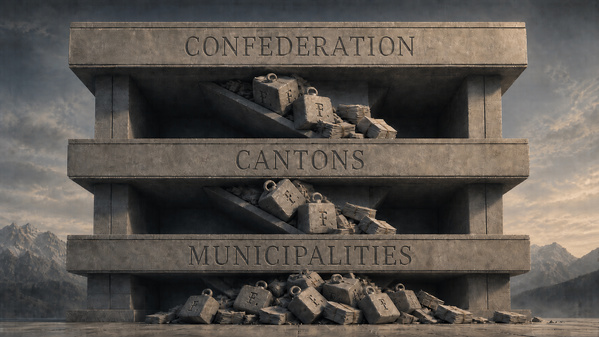
On 24 April 2026, the Swiss Confederation and the cantons released the interim report of the “Disentanglement 27” project. Estimated volume: CHF 4 billion of tasks to be transferred upwards to the Confederation, CHF 4.8 billion downwards to the cantons. Stated principle: strict budget neutrality. Public consultation runs until early July, with the final report expected by the end of 2027.
On 26 April 2026, just forty-eight hours later, the citizens of the canton of Fribourg rejected — by 68.57% — the law on the consolidation of cantonal finances (LAFE), which provided for several transfers of liabilities from the canton to its municipalities.
Forty-eight hours. On one side, a national project meticulously reviewing the allocation of tasks between two tiers of the State across 21 task groups. On the other, a popular referendum penalising precisely a shift towards the third tier — the very tier that Disentanglement 27 has carefully kept outside its scope.
The first instalment of this diptych, published last week, defended a limited thesis: French-speaking Switzerland and the canton of Fribourg would benefit from establishing a robust municipal debt brake, calibrated on the German-Swiss models. The diagnosis is correct, but incomplete. Adding a municipal brake will not be enough. Because the question that remains, after the coincidence of 24 and 26 April, runs deeper. Has the Swiss debt brake truly functioned as fiscal discipline? Or is it also, in part, a silent mechanism for the cascading downward shift of liabilities? And if so, how can it be reformed without breaking what works?
That is what this second instalment sets out to examine.
The numbers on the federal debt brake are well known. Federal debt reduced by CHF 27 billion between 2003 and 2019. Federal debt-to-GDP ratio at 13.5% in 2019, 16.1% at the end of 2025 even after the pandemic. According to Avenir Suisse, without the brake, roughly CHF 275 billion of additional debt would have accumulated since 2003. All of that is accurate.
But these figures describe a single tier. What happened during that same period on the two tiers below?
At the cantonal level, median indebtedness remained stable at around 15% of cantonal GDP between 2010 and 2020. Reassuring, on the surface. But let us look more closely at the aggregate liabilities. In Fribourg — a canton consistently ranked among the best-managed in Switzerland; Avenir Suisse noted in March 2026 that Fribourg is one of only four cantons (alongside Neuchâtel, Valais and Zug) to have budgeted a balanced or surplus result for 2025 — cantonal state expenditures doubled between 2003 and 2023, while the liabilities of Fribourg’s municipalities rose by 66% over the same period. The neighbouring canton of Vaud presents the sharpest contrast: over ten years, cantonal debt down by 35%, municipal debt up by 27%.
These two trajectories do not offset each other. They add up. The sum of cantonal and municipal debt in several French-speaking cantons increased over the very period during which federal debt was falling. This is not arithmetic coincidence. It is what happens when each tier, taken individually, is held to a discipline, but no one is holding the flows between tiers.
The Conference of Cantonal Governments (CCG) itself made this clear in September 2024, through its president Markus Dieth: “Direct shifts of liabilities, which leave cantons no room for manoeuvre, are by no means savings measures and are firmly rejected by the cantonal governments.” Florence Nater, Vice-President, reinforced the message in June 2025: “A consolidation of federal finances may receive the support of the cantons, but it cannot take place at their expense through unilateral shifts of liabilities. Taxpayers would gain nothing from such an exchange.”
When the institutional body representing the 26 cantonal governments officially and publicly denounces shifts of liabilities as a false budgetary gain, this is no longer a suspicion. It is an observation shared at the highest level of Switzerland’s institutional hierarchy. Swiss fiscal discipline is a success in the sense that each tier, measured individually, has held its aggregates. It is a partial success in the sense that the sum of individual disciplines has not produced a system-wide discipline.
This is what I call the systemic optical effect. Debt falls at the tier observed, because part of the liabilities slide down to the tier below. Seen from the Confederation, the federal brake is a success. Seen from below, that success is accompanied by a downward shift.
The mechanism became legible in June 2025, when the CCG explicitly wrote, for the first time, that the federal Relief Programme 2027 would entail “considerable shifts of liabilities towards the cantons and the municipalities.” The full cascade is now named by the institution best placed to do so.
Let us examine it concretely in Fribourg.
First shift: Confederation to cantons. The Confederation aims for CHF 3 billion in savings from 2027 onwards under its Relief Programme. A significant share of those savings comes from reducing transfers to the cantons in jointly funded areas — health insurance premium reductions, supplementary benefits, education, regional transport. The cantons, contractually bound in these tasks, absorb the impact.
Second shift: cantons to municipalities. To absorb the reduction in federal transfers, cantons under balanced-budget constraints (now nearly all of them) themselves seek to pass part of the burden down to municipalities. The Fribourg LAFE provided, among its 18 measures, several adjustments to the allocation of liabilities between the canton and its municipalities. A modest volume on paper — around CHF 10 million cumulatively over three years, according to the Council of State’s figures. But this modest volume sits within a broader consolidation programme (PAFE) targeting CHF 405 million in budgetary improvements over 2026-2028.
Third shift: municipalities to taxpayers and public services. Municipalities, caught between rigid own revenues (essentially the local tax, capped by intermunicipal and cantonal competition) and rising liabilities, are left with three levers: raise local tax coefficients, cut services, or borrow more. In Ursy, where I sit on the municipal assembly, the 2025 accounts document the third option with stark clarity: net debt ratio at 331%, self-financing rate at 1%. The margin is shrinking visibly.
On 26 April, the Fribourg electorate stopped the second shift. But the first — the federal Relief Programme 2027 — is still in motion at federal level. The canton will have to absorb it without the LAFE cushion. The pressure on municipalities does not disappear with the rejection; it redeploys into the “amended” 2026 budget that the Council of State must submit to the Grand Council at its June session, for entry into force on 1 July.
The cascade did not stop on 26 April. It was simply slowed by one notch at one specific point. The systemic diagnosis remains intact.
To understand why the cascade exists, we need to return to the great reform of 2008: the RPT (Réforme de la péréquation financière et de la répartition des tâches entre la Confédération et les cantons — the New Financial Equalisation between the Confederation and the cantons). Approved by 64% in the popular vote of November 2004, it entered into force on 1 January 2008. The first fundamental reorganisation of Switzerland’s institutional relations since 1848.
The stated objective was twofold. To reorganise financial equalisation — that is, the compensation flows between richer and poorer cantons. And to disentangle tasks — that is, to assign each mission to the most relevant tier, without opaque co-financing.
On the first count, success. Today’s equalisation system redistributes CHF 6.4 billion in 2026, two thirds of it via the Confederation, and disparities between high and low resource potential cantons have markedly diminished. This mechanism, despite criticism of its disempowering effect on recipient cantons, works.
On the second count, partial failure. As Avenir Suisse documented in its study RPT 2 — For a revitalisation of Swiss federalism (2017, updated 2021): “Under the RPT, only 40% of joint competences were disentangled, while the Confederation and the cantons continue to share responsibility for 17 tasks.” Of the 53 tasks jointly funded before 2008, only 21 were properly disaggregated and clearly reallocated. The rest — the majority — remained in co-financing.
Bernard Dafflon, Professor Emeritus of Public Finance at the University of Fribourg, had set out the diagnosis as early as 2010, in his University of Fribourg working paper Local debt: from budget responsibility to fiscal discipline. His thesis was clear: fiscal discipline at one tier only makes sense if the allocation of tasks between tiers is clear and stable. When it is not, discipline produces displacement rather than savings. Fifteen years later, this is precisely what the Swiss trajectory of 2008-2025 documents.
The RPT disciplined the financial flows (equalisation), but it left unfinished the discipline of task flows (disentanglement). The result, two decades later, is exactly what we observe: a system in which each tier is held in check, but in which tasks slide between tiers without overall governance.
In the same study, Avenir Suisse proposed a way out: an automatic mechanism for the transfer of fiscal sovereignty, enshrined in the Federal Constitution. The principle: every transfer of a task from one tier to another is accompanied, simultaneously and proportionately, by the transfer of the corresponding fiscal competence. No more ad hoc political debates with each adjustment. A rule, automatic, that makes budget neutrality enforceable and operational. The volume envisaged for the cantons was around CHF 10 billion.
This proposal, formulated by a liberal think tank, was not taken up by the Disentanglement 27 project. A gap that the next phase of the project should correct.
The Disentanglement 27 project, launched in June 2024 by the Federal Council and the Conference of Cantonal Governments, is the logical sequel to the RPT. Its ambition is explicit: take up the tasks the RPT 2008 could not disentangle, and examine 21 task groups without taboo.
The interim report published on 24 April 2026 delivers an initial verdict. Of the 21 groups examined, 14 show disentanglement potential. A consensus has emerged on roughly half of those 14 areas (supplementary benefits, rail infrastructure, military administration, tertiary education subsidies). For the other half, variants remain under discussion (regional transport, road financing, vocational training, building culture).
This is a serious, ambitious, sustained, and politically legitimate project. It deserves credit.
But it has a blind spot. The project examines the allocation between two tiers: Confederation and cantons. Not three. The consultation running until early July 2026 is open to “cantons, cities and municipalities” — a cosmetic formulation: municipalities are heard, but the project’s scope does not include them as a tier of allocation. They can comment; they cannot negotiate.
It is the same mechanism as in Germany, where the constitutional debt brake of 2009 covers only the Federation and the Länder, explicitly excluding the municipalities (Article 109 of the Basic Law). The German outcome was set out in the first instalment: cumulative municipal deficit of EUR 31.9 billion in 2025, the worst since reunification. Eleven thousand municipalities and 295 districts (Landkreise) are left outside the federal device, and it is precisely where they are forgotten that debt accumulates silently.
Switzerland has a chance Germany did not have: its disentanglement project is not constitutionally closed; it is in progress. The final report is not expected before the end of 2027. There are two years to broaden the scope, or to prepare a complementary project.
That is why I propose here, without polemics but with clarity, that the next project be named now: Disentanglement 28. A twin project, calibrated on the same methodology, the same principle of budget neutrality, the same final-report horizon, but bearing on the canton-municipality pair. Without D28, D27 will succeed in clarifying flows between the two upper tiers and will leave intact — or even worsen — the opacity of the third.
This is not one more project. It is the other half of the same project.
If the cascade is the problem, integrated architecture is the answer. Four principles can guide an overhaul that does not destroy what works, but completes what is missing.
Principle 1: strict budget neutrality with an automatic mechanism for the transfer of fiscal sovereignty. This is the Avenir Suisse RPT 2 proposal, transposed to three tiers. Concretely: if the Confederation transfers a task valued at CHF 500 million to the cantons, the constitutional mechanism automatically transfers a corresponding fraction of direct federal tax or VAT — calibrated according to a fixed legal formula — to cantonal fiscal sovereignty. No political debate on cost evaluation. No parliamentary haggling at each revision. The rule applies. The same between cantons and municipalities: every task transfer is accompanied by a proportionate transfer of the municipal share of cantonal tax. This is the only way to make budget neutrality something more than a slogan repeated in the press releases of the CCG.
Principle 2: symmetrical brake architecture at every tier. If the Confederation has a brake, and if nearly all cantons have a brake, then every municipality must have one — calibrated to its size. A municipality of 200 inhabitants does not have the same budgetary structure as a city of 30,000 — the calibration differs, the principle does not. The models exist and were detailed in the first instalment: Lucerne with its law on municipal finance (FHGG), stacking four binding indicators; Solothurn with its Watchlist, graduated across four phases of progressive supervision; Zurich with its hybrid architecture, allowing the most exposed municipalities to impose their own rules. Three architectures, three balances between cantonal rigour and local autonomy. The supervisory layer itself follows the institutional architecture of each canton: the district prefect (Oberamtmann in the canton of Fribourg, Regierungsstatthalter in the canton of Bern) — already competent on municipal budgets, who would simply need to be properly equipped — a court of audit elsewhere, direct cantonal authority in cantons without an intermediate level. The principle does not depend on the layer; the layer depends on each canton’s institutional history. Symmetry is not an aesthetic luxury: it is what makes the cascade visible and negotiable rather than invisible and endured.
Principle 3: democratic legibility restored. Swiss citizens accepted the federal brake by 84.7% in 2001 because they understood its purpose. They rejected the LAFE by 68.57% in April 2026 because they perceived an opaque transfer mechanism. Between the two, what has degraded is legibility. An integrated overhaul must restore the traceability of transfers: who decides, who pays, who executes, who is accountable. This is exactly the diagnosis that Bernard Dafflon set out as early as 2010: fiscal discipline presupposes fiscal responsibility, which itself presupposes clarity of competences. Without clarity, no responsibility; without responsibility, no real discipline.
Principle 4: horizontal oversight of transfers. What is most lacking today is a body or instrument that measures and publishes, in real time, the net flows between tiers. The CCG does so through communiqués, on a punctual and political basis. The Confederation does so for equalisation, but not for implicit transfers. An independent observatory — or an extended mandate to the Federal Finance Administration — that would produce an annual public report on the flows between Confederation, cantons and municipalities would be the basic instrument of a three-tier budgetary democracy. What the Solothurn Watchlist does at cantonal level, an analogous device could do at national level.
These four principles are not revolutionary. They already exist, in part, in the models cited. What is missing is their coherent integration. And the political opportunity to push it forward.
One objection deserves to be addressed head-on. The economic right, legitimately attentive to the principle of subsidiarity, might see in this proposal “more state, more complexity.” The opposite is true. An integrated architecture reduces entanglement, because it clarifies who does what and who pays for what. The current complexity does not come from integration; it comes precisely from its absence. It is opaque co-financing, unilateral transfers and ad hoc adjustments that consume political energy. A stable, automatic, transparent constitutional rule consumes less state than a patchwork negotiated case by case.
The opportunity is now. Three elements compose it.
First element: Disentanglement 27 is open, in consultation until July 2026, with a final report due at the end of 2027. There are two years to broaden the scope, or to prepare the twin D28 project. This is precisely the window the RPT had between 2001 and 2008. That window will not reopen any time soon.
Second element: the LAFE rejection of 26 April has politically raised the value of a clear debate on transfers. The Fribourg electorate did not refuse rigour. It refused a rigour perceived as late, opaque and displaced. An integrated overhaul, transparent, negotiated in cool conditions rather than in haste, has a chance of winning support that another cantonal austerity plan would not. The political timing is rare.
Third element: Switzerland is negotiating this issue from a position of strength. Federal public debt at 16.1% of GDP. Four cantons (FR, NE, VS, ZG) at balance or surplus for 2025. Equalisation at 0.8% of national GDP. There is no financial emergency forcing the debate to be hurried.
The counter-example is France. According to INSEE data and analyses by the Cour des comptes for 2025, French public debt reached 115.6% of GDP in the second quarter, totalling EUR 3,416 billion. The 2024 deficit stood at 6.0% of GDP, and the trajectory for returning below the 3% threshold has already been postponed twice — from 2027 to 2029. The Cour des comptes now estimates the necessary structural adjustment at EUR 110 billion, twice the 2023 estimate.
In this context, French local authorities are forced to contribute to the budgetary effort under emergency conditions, without any institutional debate of substance on the allocation of competences. The municipal block endures Parisian arbitrations; it does not negotiate them. This is precisely the situation Switzerland can avoid by acting now. Anticipate rather than react. Overhaul in cool conditions rather than patch in haste. The Swiss art of substantive reform has always been this: to take ten years to build an RPT that holds for sixty. Disentanglement 27, complemented by a D28 covering municipalities, is exactly that kind of undertaking.
I have lived this discussion in fragments. In St Gallen, where I studied business administration at the HSG, I saw how Swiss-German fiscal prudence transmitted itself through culture as much as through law. In Olten, in Zurich, I heard municipal votes on Voranschläge settled in neighbourhood assemblies as if they were democratic self-evidences. In Forel-Lavaux, then in Montet (Glâne) before the merger with Ursy, I saw how those mechanisms thinned out in French-speaking Switzerland, for lack of tools. Today in Ursy, I see the figures that result. Thirty years working in two languages, ten years in the canton of St Gallen, ten years in the canton of Zurich, and now Fribourg: the Röstigraben — Switzerland’s symbolic linguistic divide — is not a Röstigraben of cultures. It is a Röstigraben of tools.
And tools can be built.
On 24 April 2026, Switzerland set itself to the task of Disentanglement 27. On 26 April, it said no to a consolidation perceived as a transfer. Between those two dates lies a conversation to be had: the one that adds the third tier to the work begun on the first two, that enshrines in the Constitution an automatic mechanism for the transfer of fiscal sovereignty, that restores the democratic legibility of flows between tiers, and that equips Switzerland with an observatory of transfers worthy of its disciplinary ambitions.
This diptych proposed two converging theses. First: French-speaking Switzerland and Fribourg need a calibrated municipal debt brake. Second: Switzerland needs an integrated overhaul of its three-tier fiscal federalism, of which Disentanglement 27 is only the visible half.
Anticipate, lest compaction become collapse. Integrate, because none of the three isolated disciplines has held the cascade. Enshrine in the Constitution, because a constitutional mechanism outlasts political contingency.
Disentanglement 27 and Federal Relief Programme 2027
Federal Council / Conference of Cantonal Governments (CCG), press release “Fresh start for the project on the allocation of tasks between the Confederation and the cantons”, 21 June 2024 ; Federal Finance Administration (FFA), press release “Launch of the Disentanglement 27 project”, 28 February 2025 ; CCG, dedicated page “Financial equalisation and allocation of tasks” (April 2026 update) ; Le Temps, “‘This is not a savings programme’: the allocation of federal and cantonal tasks is being reviewed”, 24 April 2026 ; SRF and RTS, news reports “The Confederation and the cantons want to clarify their respective roles”, 24 April 2026 ; Federal Department of Finance (FDF), page “Federal Relief Programme 2027”, 2025-2026 update ; FFA, press release “The Federal Council adjusts the broad lines of the Federal Relief Programme 2027 and adopts the 2026 budget”, 25 June 2025.
Institutional position of the cantons on transfers
CCG, press release “The cantons reject shifts of liabilities”, 20 September 2024 (statement by Markus Dieth) ; CCG, press release “Federal Relief Programme 2027: more work needed despite improvements”, June 2025 (statement by Florence Nater) ; CCG, press release “The cantons call on the Federal Council to revise its savings programme”, 2025.
RPT 2008 and assessment
Federal Council, Fourth Effectiveness Report on Financial Equalisation between the Confederation and the Cantons 2020-2025, 2025 ; Avenir Suisse, RPT 2 — For a revitalisation of Swiss federalism, Lukas Rühli and Natanael Rother, 2017 (updated 2021) ; Avenir Suisse, The labyrinth of financial equalisation, cantonal monitoring, 2014 (with updates) ; Avenir Suisse, blog “Financial equalisation: beware of adding too much sugar”, 26 August 2024 ; Bernard Dafflon, Local debt: from budget responsibility to fiscal discipline, FSES Working Papers 417, Faculty of Economics and Social Sciences, University of Freiburg/Fribourg Switzerland, 2010 ; Bernard Dafflon, La gestion des finances publiques locales, Paris: Economica, 1994 (subsequent editions) ; Bernard Dafflon, Panorama des impôts en Suisse. Du local au fédéral, entre équité et concurrence: quels enjeux?, Domaine Public, 2014 ; Bernard Dafflon, “La répartition des tâches cantons-communes ou le rendez-vous manqué des réformes”, University of Fribourg.
Federal debt brake and effectiveness studies
Federal Finance Administration (FFA), The Debt Brake, FDF brochure, 2023 ; Christian Pfeil and Lars P. Feld, Does the Swiss Debt Brake Induce Sound Federal Finances? A Synthetic Control Analysis, Public Finance Review, 2024 ; Avenir Suisse, blog “Cantonal annual accounts: from red to green”, March 2026 ; Avenir Suisse, Loosening the debt brake: nothing comes for free, 2024.
Fribourg — LAFE and the “amended” 2026 budget
Canton of Fribourg, Council of State, press release “Law on the consolidation of cantonal finances (LAFE): the Council of State takes note of its rejection by the Fribourg population”, 27 April 2026 ; Canton of Fribourg, Council of State, press release “The Council of State has adopted an ordinance defining indispensable expenditure in the absence of a 2026 budget”, 10 December 2025 ; RTS, “Law on the consolidation of cantonal finances rejected in Fribourg, a setback for the Council of State”, 26 April 2026 ; Le Temps, “Law on the consolidation of cantonal finances rejected in Fribourg, a major defeat for the government”, 26 April 2026 ; Avenir Suisse, blog “Cantonal annual accounts: from red to green”, Fribourg analysis, March 2026.
Trajectories: Vaud, Fribourg, municipalities
DETTEC FR, cantonal vote of 12 November 2023 (figures: Fribourg state liabilities doubled 2003-2023, Fribourg municipal liabilities +66%) ; Canton of Vaud, press release “Deficit accounts: the Council of State must activate the financial consolidation law”, 2025 ; Union of Vaud Municipalities (UCV), publication “Municipal Finance”, September 2025 ; Canton of Jura, Report on Municipal Finances 2022 and 2023, Delegate for Communal Affairs ; Municipality of Ursy, Report on the 2025 accounts, Chapter 11.
France comparison
Cour des comptes, La situation des finances publiques début 2025, February 2025 ; INSEE and French Ministry of Economy, Décryptage : 5 minutes pour comprendre la dette publique, Q2 2025 data ; OFCE, Quelles trajectoires pour les finances publiques de la France?, Policy Brief 146, 2025 ; Vie-publique.fr, Dette et dépenses publiques en 2025 : où est la France par rapport à ses partenaires?, September 2025.
Germany comparison
Statistisches Bundesamt (Destatis), provisional 2025 data on German municipal deficits ; Federal Ministry of Finance, Schuldenbremse — Articles 109 and 115 of the Basic Law.
Article 1/2
Mathieu Janin, “Debt brake (1/2): the Swiss success that stops at the door of the municipalities”, Mathieu Janin’s Blog, 29 April 2026.
On 26 April 2026, just forty-eight hours later, the citizens of the canton of Fribourg rejected — by 68.57% — the law on the consolidation of cantonal finances (LAFE), which provided for several transfers of liabilities from the canton to its municipalities.
Forty-eight hours. On one side, a national project meticulously reviewing the allocation of tasks between two tiers of the State across 21 task groups. On the other, a popular referendum penalising precisely a shift towards the third tier — the very tier that Disentanglement 27 has carefully kept outside its scope.
The first instalment of this diptych, published last week, defended a limited thesis: French-speaking Switzerland and the canton of Fribourg would benefit from establishing a robust municipal debt brake, calibrated on the German-Swiss models. The diagnosis is correct, but incomplete. Adding a municipal brake will not be enough. Because the question that remains, after the coincidence of 24 and 26 April, runs deeper. Has the Swiss debt brake truly functioned as fiscal discipline? Or is it also, in part, a silent mechanism for the cascading downward shift of liabilities? And if so, how can it be reformed without breaking what works?
That is what this second instalment sets out to examine.
The federal success: only part of the story
The numbers on the federal debt brake are well known. Federal debt reduced by CHF 27 billion between 2003 and 2019. Federal debt-to-GDP ratio at 13.5% in 2019, 16.1% at the end of 2025 even after the pandemic. According to Avenir Suisse, without the brake, roughly CHF 275 billion of additional debt would have accumulated since 2003. All of that is accurate.
But these figures describe a single tier. What happened during that same period on the two tiers below?
At the cantonal level, median indebtedness remained stable at around 15% of cantonal GDP between 2010 and 2020. Reassuring, on the surface. But let us look more closely at the aggregate liabilities. In Fribourg — a canton consistently ranked among the best-managed in Switzerland; Avenir Suisse noted in March 2026 that Fribourg is one of only four cantons (alongside Neuchâtel, Valais and Zug) to have budgeted a balanced or surplus result for 2025 — cantonal state expenditures doubled between 2003 and 2023, while the liabilities of Fribourg’s municipalities rose by 66% over the same period. The neighbouring canton of Vaud presents the sharpest contrast: over ten years, cantonal debt down by 35%, municipal debt up by 27%.
These two trajectories do not offset each other. They add up. The sum of cantonal and municipal debt in several French-speaking cantons increased over the very period during which federal debt was falling. This is not arithmetic coincidence. It is what happens when each tier, taken individually, is held to a discipline, but no one is holding the flows between tiers.
The Conference of Cantonal Governments (CCG) itself made this clear in September 2024, through its president Markus Dieth: “Direct shifts of liabilities, which leave cantons no room for manoeuvre, are by no means savings measures and are firmly rejected by the cantonal governments.” Florence Nater, Vice-President, reinforced the message in June 2025: “A consolidation of federal finances may receive the support of the cantons, but it cannot take place at their expense through unilateral shifts of liabilities. Taxpayers would gain nothing from such an exchange.”
When the institutional body representing the 26 cantonal governments officially and publicly denounces shifts of liabilities as a false budgetary gain, this is no longer a suspicion. It is an observation shared at the highest level of Switzerland’s institutional hierarchy. Swiss fiscal discipline is a success in the sense that each tier, measured individually, has held its aggregates. It is a partial success in the sense that the sum of individual disciplines has not produced a system-wide discipline.
This is what I call the systemic optical effect. Debt falls at the tier observed, because part of the liabilities slide down to the tier below. Seen from the Confederation, the federal brake is a success. Seen from below, that success is accompanied by a downward shift.
The cascade in three stages
The mechanism became legible in June 2025, when the CCG explicitly wrote, for the first time, that the federal Relief Programme 2027 would entail “considerable shifts of liabilities towards the cantons and the municipalities.” The full cascade is now named by the institution best placed to do so.
Let us examine it concretely in Fribourg.
First shift: Confederation to cantons. The Confederation aims for CHF 3 billion in savings from 2027 onwards under its Relief Programme. A significant share of those savings comes from reducing transfers to the cantons in jointly funded areas — health insurance premium reductions, supplementary benefits, education, regional transport. The cantons, contractually bound in these tasks, absorb the impact.
Second shift: cantons to municipalities. To absorb the reduction in federal transfers, cantons under balanced-budget constraints (now nearly all of them) themselves seek to pass part of the burden down to municipalities. The Fribourg LAFE provided, among its 18 measures, several adjustments to the allocation of liabilities between the canton and its municipalities. A modest volume on paper — around CHF 10 million cumulatively over three years, according to the Council of State’s figures. But this modest volume sits within a broader consolidation programme (PAFE) targeting CHF 405 million in budgetary improvements over 2026-2028.
Third shift: municipalities to taxpayers and public services. Municipalities, caught between rigid own revenues (essentially the local tax, capped by intermunicipal and cantonal competition) and rising liabilities, are left with three levers: raise local tax coefficients, cut services, or borrow more. In Ursy, where I sit on the municipal assembly, the 2025 accounts document the third option with stark clarity: net debt ratio at 331%, self-financing rate at 1%. The margin is shrinking visibly.
On 26 April, the Fribourg electorate stopped the second shift. But the first — the federal Relief Programme 2027 — is still in motion at federal level. The canton will have to absorb it without the LAFE cushion. The pressure on municipalities does not disappear with the rejection; it redeploys into the “amended” 2026 budget that the Council of State must submit to the Grand Council at its June session, for entry into force on 1 July.
The cascade did not stop on 26 April. It was simply slowed by one notch at one specific point. The systemic diagnosis remains intact.
RPT 2008: what was attempted, what fell short
To understand why the cascade exists, we need to return to the great reform of 2008: the RPT (Réforme de la péréquation financière et de la répartition des tâches entre la Confédération et les cantons — the New Financial Equalisation between the Confederation and the cantons). Approved by 64% in the popular vote of November 2004, it entered into force on 1 January 2008. The first fundamental reorganisation of Switzerland’s institutional relations since 1848.
The stated objective was twofold. To reorganise financial equalisation — that is, the compensation flows between richer and poorer cantons. And to disentangle tasks — that is, to assign each mission to the most relevant tier, without opaque co-financing.
On the first count, success. Today’s equalisation system redistributes CHF 6.4 billion in 2026, two thirds of it via the Confederation, and disparities between high and low resource potential cantons have markedly diminished. This mechanism, despite criticism of its disempowering effect on recipient cantons, works.
On the second count, partial failure. As Avenir Suisse documented in its study RPT 2 — For a revitalisation of Swiss federalism (2017, updated 2021): “Under the RPT, only 40% of joint competences were disentangled, while the Confederation and the cantons continue to share responsibility for 17 tasks.” Of the 53 tasks jointly funded before 2008, only 21 were properly disaggregated and clearly reallocated. The rest — the majority — remained in co-financing.
Bernard Dafflon, Professor Emeritus of Public Finance at the University of Fribourg, had set out the diagnosis as early as 2010, in his University of Fribourg working paper Local debt: from budget responsibility to fiscal discipline. His thesis was clear: fiscal discipline at one tier only makes sense if the allocation of tasks between tiers is clear and stable. When it is not, discipline produces displacement rather than savings. Fifteen years later, this is precisely what the Swiss trajectory of 2008-2025 documents.
The RPT disciplined the financial flows (equalisation), but it left unfinished the discipline of task flows (disentanglement). The result, two decades later, is exactly what we observe: a system in which each tier is held in check, but in which tasks slide between tiers without overall governance.
In the same study, Avenir Suisse proposed a way out: an automatic mechanism for the transfer of fiscal sovereignty, enshrined in the Federal Constitution. The principle: every transfer of a task from one tier to another is accompanied, simultaneously and proportionately, by the transfer of the corresponding fiscal competence. No more ad hoc political debates with each adjustment. A rule, automatic, that makes budget neutrality enforceable and operational. The volume envisaged for the cantons was around CHF 10 billion.
This proposal, formulated by a liberal think tank, was not taken up by the Disentanglement 27 project. A gap that the next phase of the project should correct.
Disentanglement 27: a two-tier project, with consultation across three
The Disentanglement 27 project, launched in June 2024 by the Federal Council and the Conference of Cantonal Governments, is the logical sequel to the RPT. Its ambition is explicit: take up the tasks the RPT 2008 could not disentangle, and examine 21 task groups without taboo.
The interim report published on 24 April 2026 delivers an initial verdict. Of the 21 groups examined, 14 show disentanglement potential. A consensus has emerged on roughly half of those 14 areas (supplementary benefits, rail infrastructure, military administration, tertiary education subsidies). For the other half, variants remain under discussion (regional transport, road financing, vocational training, building culture).
This is a serious, ambitious, sustained, and politically legitimate project. It deserves credit.
But it has a blind spot. The project examines the allocation between two tiers: Confederation and cantons. Not three. The consultation running until early July 2026 is open to “cantons, cities and municipalities” — a cosmetic formulation: municipalities are heard, but the project’s scope does not include them as a tier of allocation. They can comment; they cannot negotiate.
It is the same mechanism as in Germany, where the constitutional debt brake of 2009 covers only the Federation and the Länder, explicitly excluding the municipalities (Article 109 of the Basic Law). The German outcome was set out in the first instalment: cumulative municipal deficit of EUR 31.9 billion in 2025, the worst since reunification. Eleven thousand municipalities and 295 districts (Landkreise) are left outside the federal device, and it is precisely where they are forgotten that debt accumulates silently.
Switzerland has a chance Germany did not have: its disentanglement project is not constitutionally closed; it is in progress. The final report is not expected before the end of 2027. There are two years to broaden the scope, or to prepare a complementary project.
That is why I propose here, without polemics but with clarity, that the next project be named now: Disentanglement 28. A twin project, calibrated on the same methodology, the same principle of budget neutrality, the same final-report horizon, but bearing on the canton-municipality pair. Without D28, D27 will succeed in clarifying flows between the two upper tiers and will leave intact — or even worsen — the opacity of the third.
This is not one more project. It is the other half of the same project.
Four principles for an integrated overhaul
If the cascade is the problem, integrated architecture is the answer. Four principles can guide an overhaul that does not destroy what works, but completes what is missing.
Principle 1: strict budget neutrality with an automatic mechanism for the transfer of fiscal sovereignty. This is the Avenir Suisse RPT 2 proposal, transposed to three tiers. Concretely: if the Confederation transfers a task valued at CHF 500 million to the cantons, the constitutional mechanism automatically transfers a corresponding fraction of direct federal tax or VAT — calibrated according to a fixed legal formula — to cantonal fiscal sovereignty. No political debate on cost evaluation. No parliamentary haggling at each revision. The rule applies. The same between cantons and municipalities: every task transfer is accompanied by a proportionate transfer of the municipal share of cantonal tax. This is the only way to make budget neutrality something more than a slogan repeated in the press releases of the CCG.
Principle 2: symmetrical brake architecture at every tier. If the Confederation has a brake, and if nearly all cantons have a brake, then every municipality must have one — calibrated to its size. A municipality of 200 inhabitants does not have the same budgetary structure as a city of 30,000 — the calibration differs, the principle does not. The models exist and were detailed in the first instalment: Lucerne with its law on municipal finance (FHGG), stacking four binding indicators; Solothurn with its Watchlist, graduated across four phases of progressive supervision; Zurich with its hybrid architecture, allowing the most exposed municipalities to impose their own rules. Three architectures, three balances between cantonal rigour and local autonomy. The supervisory layer itself follows the institutional architecture of each canton: the district prefect (Oberamtmann in the canton of Fribourg, Regierungsstatthalter in the canton of Bern) — already competent on municipal budgets, who would simply need to be properly equipped — a court of audit elsewhere, direct cantonal authority in cantons without an intermediate level. The principle does not depend on the layer; the layer depends on each canton’s institutional history. Symmetry is not an aesthetic luxury: it is what makes the cascade visible and negotiable rather than invisible and endured.
Principle 3: democratic legibility restored. Swiss citizens accepted the federal brake by 84.7% in 2001 because they understood its purpose. They rejected the LAFE by 68.57% in April 2026 because they perceived an opaque transfer mechanism. Between the two, what has degraded is legibility. An integrated overhaul must restore the traceability of transfers: who decides, who pays, who executes, who is accountable. This is exactly the diagnosis that Bernard Dafflon set out as early as 2010: fiscal discipline presupposes fiscal responsibility, which itself presupposes clarity of competences. Without clarity, no responsibility; without responsibility, no real discipline.
Principle 4: horizontal oversight of transfers. What is most lacking today is a body or instrument that measures and publishes, in real time, the net flows between tiers. The CCG does so through communiqués, on a punctual and political basis. The Confederation does so for equalisation, but not for implicit transfers. An independent observatory — or an extended mandate to the Federal Finance Administration — that would produce an annual public report on the flows between Confederation, cantons and municipalities would be the basic instrument of a three-tier budgetary democracy. What the Solothurn Watchlist does at cantonal level, an analogous device could do at national level.
These four principles are not revolutionary. They already exist, in part, in the models cited. What is missing is their coherent integration. And the political opportunity to push it forward.
One objection deserves to be addressed head-on. The economic right, legitimately attentive to the principle of subsidiarity, might see in this proposal “more state, more complexity.” The opposite is true. An integrated architecture reduces entanglement, because it clarifies who does what and who pays for what. The current complexity does not come from integration; it comes precisely from its absence. It is opaque co-financing, unilateral transfers and ad hoc adjustments that consume political energy. A stable, automatic, transparent constitutional rule consumes less state than a patchwork negotiated case by case.
The historical moment
The opportunity is now. Three elements compose it.
First element: Disentanglement 27 is open, in consultation until July 2026, with a final report due at the end of 2027. There are two years to broaden the scope, or to prepare the twin D28 project. This is precisely the window the RPT had between 2001 and 2008. That window will not reopen any time soon.
Second element: the LAFE rejection of 26 April has politically raised the value of a clear debate on transfers. The Fribourg electorate did not refuse rigour. It refused a rigour perceived as late, opaque and displaced. An integrated overhaul, transparent, negotiated in cool conditions rather than in haste, has a chance of winning support that another cantonal austerity plan would not. The political timing is rare.
Third element: Switzerland is negotiating this issue from a position of strength. Federal public debt at 16.1% of GDP. Four cantons (FR, NE, VS, ZG) at balance or surplus for 2025. Equalisation at 0.8% of national GDP. There is no financial emergency forcing the debate to be hurried.
The counter-example is France. According to INSEE data and analyses by the Cour des comptes for 2025, French public debt reached 115.6% of GDP in the second quarter, totalling EUR 3,416 billion. The 2024 deficit stood at 6.0% of GDP, and the trajectory for returning below the 3% threshold has already been postponed twice — from 2027 to 2029. The Cour des comptes now estimates the necessary structural adjustment at EUR 110 billion, twice the 2023 estimate.
In this context, French local authorities are forced to contribute to the budgetary effort under emergency conditions, without any institutional debate of substance on the allocation of competences. The municipal block endures Parisian arbitrations; it does not negotiate them. This is precisely the situation Switzerland can avoid by acting now. Anticipate rather than react. Overhaul in cool conditions rather than patch in haste. The Swiss art of substantive reform has always been this: to take ten years to build an RPT that holds for sixty. Disentanglement 27, complemented by a D28 covering municipalities, is exactly that kind of undertaking.
The work that remains
I have lived this discussion in fragments. In St Gallen, where I studied business administration at the HSG, I saw how Swiss-German fiscal prudence transmitted itself through culture as much as through law. In Olten, in Zurich, I heard municipal votes on Voranschläge settled in neighbourhood assemblies as if they were democratic self-evidences. In Forel-Lavaux, then in Montet (Glâne) before the merger with Ursy, I saw how those mechanisms thinned out in French-speaking Switzerland, for lack of tools. Today in Ursy, I see the figures that result. Thirty years working in two languages, ten years in the canton of St Gallen, ten years in the canton of Zurich, and now Fribourg: the Röstigraben — Switzerland’s symbolic linguistic divide — is not a Röstigraben of cultures. It is a Röstigraben of tools.
And tools can be built.
Conclusion
On 24 April 2026, Switzerland set itself to the task of Disentanglement 27. On 26 April, it said no to a consolidation perceived as a transfer. Between those two dates lies a conversation to be had: the one that adds the third tier to the work begun on the first two, that enshrines in the Constitution an automatic mechanism for the transfer of fiscal sovereignty, that restores the democratic legibility of flows between tiers, and that equips Switzerland with an observatory of transfers worthy of its disciplinary ambitions.
This diptych proposed two converging theses. First: French-speaking Switzerland and Fribourg need a calibrated municipal debt brake. Second: Switzerland needs an integrated overhaul of its three-tier fiscal federalism, of which Disentanglement 27 is only the visible half.
Anticipate, lest compaction become collapse. Integrate, because none of the three isolated disciplines has held the cascade. Enshrine in the Constitution, because a constitutional mechanism outlasts political contingency.
Sources
Disentanglement 27 and Federal Relief Programme 2027
Federal Council / Conference of Cantonal Governments (CCG), press release “Fresh start for the project on the allocation of tasks between the Confederation and the cantons”, 21 June 2024 ; Federal Finance Administration (FFA), press release “Launch of the Disentanglement 27 project”, 28 February 2025 ; CCG, dedicated page “Financial equalisation and allocation of tasks” (April 2026 update) ; Le Temps, “‘This is not a savings programme’: the allocation of federal and cantonal tasks is being reviewed”, 24 April 2026 ; SRF and RTS, news reports “The Confederation and the cantons want to clarify their respective roles”, 24 April 2026 ; Federal Department of Finance (FDF), page “Federal Relief Programme 2027”, 2025-2026 update ; FFA, press release “The Federal Council adjusts the broad lines of the Federal Relief Programme 2027 and adopts the 2026 budget”, 25 June 2025.
Institutional position of the cantons on transfers
CCG, press release “The cantons reject shifts of liabilities”, 20 September 2024 (statement by Markus Dieth) ; CCG, press release “Federal Relief Programme 2027: more work needed despite improvements”, June 2025 (statement by Florence Nater) ; CCG, press release “The cantons call on the Federal Council to revise its savings programme”, 2025.
RPT 2008 and assessment
Federal Council, Fourth Effectiveness Report on Financial Equalisation between the Confederation and the Cantons 2020-2025, 2025 ; Avenir Suisse, RPT 2 — For a revitalisation of Swiss federalism, Lukas Rühli and Natanael Rother, 2017 (updated 2021) ; Avenir Suisse, The labyrinth of financial equalisation, cantonal monitoring, 2014 (with updates) ; Avenir Suisse, blog “Financial equalisation: beware of adding too much sugar”, 26 August 2024 ; Bernard Dafflon, Local debt: from budget responsibility to fiscal discipline, FSES Working Papers 417, Faculty of Economics and Social Sciences, University of Freiburg/Fribourg Switzerland, 2010 ; Bernard Dafflon, La gestion des finances publiques locales, Paris: Economica, 1994 (subsequent editions) ; Bernard Dafflon, Panorama des impôts en Suisse. Du local au fédéral, entre équité et concurrence: quels enjeux?, Domaine Public, 2014 ; Bernard Dafflon, “La répartition des tâches cantons-communes ou le rendez-vous manqué des réformes”, University of Fribourg.
Federal debt brake and effectiveness studies
Federal Finance Administration (FFA), The Debt Brake, FDF brochure, 2023 ; Christian Pfeil and Lars P. Feld, Does the Swiss Debt Brake Induce Sound Federal Finances? A Synthetic Control Analysis, Public Finance Review, 2024 ; Avenir Suisse, blog “Cantonal annual accounts: from red to green”, March 2026 ; Avenir Suisse, Loosening the debt brake: nothing comes for free, 2024.
Fribourg — LAFE and the “amended” 2026 budget
Canton of Fribourg, Council of State, press release “Law on the consolidation of cantonal finances (LAFE): the Council of State takes note of its rejection by the Fribourg population”, 27 April 2026 ; Canton of Fribourg, Council of State, press release “The Council of State has adopted an ordinance defining indispensable expenditure in the absence of a 2026 budget”, 10 December 2025 ; RTS, “Law on the consolidation of cantonal finances rejected in Fribourg, a setback for the Council of State”, 26 April 2026 ; Le Temps, “Law on the consolidation of cantonal finances rejected in Fribourg, a major defeat for the government”, 26 April 2026 ; Avenir Suisse, blog “Cantonal annual accounts: from red to green”, Fribourg analysis, March 2026.
Trajectories: Vaud, Fribourg, municipalities
DETTEC FR, cantonal vote of 12 November 2023 (figures: Fribourg state liabilities doubled 2003-2023, Fribourg municipal liabilities +66%) ; Canton of Vaud, press release “Deficit accounts: the Council of State must activate the financial consolidation law”, 2025 ; Union of Vaud Municipalities (UCV), publication “Municipal Finance”, September 2025 ; Canton of Jura, Report on Municipal Finances 2022 and 2023, Delegate for Communal Affairs ; Municipality of Ursy, Report on the 2025 accounts, Chapter 11.
France comparison
Cour des comptes, La situation des finances publiques début 2025, February 2025 ; INSEE and French Ministry of Economy, Décryptage : 5 minutes pour comprendre la dette publique, Q2 2025 data ; OFCE, Quelles trajectoires pour les finances publiques de la France?, Policy Brief 146, 2025 ; Vie-publique.fr, Dette et dépenses publiques en 2025 : où est la France par rapport à ses partenaires?, September 2025.
Germany comparison
Statistisches Bundesamt (Destatis), provisional 2025 data on German municipal deficits ; Federal Ministry of Finance, Schuldenbremse — Articles 109 and 115 of the Basic Law.
Article 1/2
Mathieu Janin, “Debt brake (1/2): the Swiss success that stops at the door of the municipalities”, Mathieu Janin’s Blog, 29 April 2026.


 Accueil


